Arabic for Beginners: 7 Easy Tips to Learn Arabic Easily
Arabic Beginners: A Simple Guide to Learning Arabic
Meta Description: Learn Arabic for beginners with simple lessons, useful vocabulary, pronunciation tips, grammar basics, and practical strategies for confident communication.
Introduction
Learning a new language can feel challenging at first, especially when the language uses a different writing system and has unfamiliar sounds. For Arabic beginners, however, the learning process can become much easier when it is approached step by step. Arabic is one of the world’s most widely spoken languages and is used across the Middle East and North Africa. It is also an important language for travel, business, culture, education, and communication.
For someone starting from zero, Arabic may initially look complicated because of its unique alphabet, right-to-left writing direction, pronunciation, and grammar. Yet these features become much more understandable with regular practice. The key is not trying to memorize everything at once. Instead, beginners should build a strong foundation by learning the Arabic alphabet, common words, basic pronunciation, simple sentence structures, and everyday expressions.
This guide is designed specifically for Arabic beginners who want to understand where to start and how to make steady progress. Whether you want to learn Arabic for travel, work, conversation, religious studies, cultural understanding, or personal development, a structured approach can help you develop useful skills without becoming overwhelmed.
Arabic for Beginners
Arabic belongs to the Semitic language family and has a rich history that spans thousands of years. Modern Arabic exists in several forms, which is an important concept for beginners to understand before choosing their learning materials.
Modern Standard Arabic
Modern Standard Arabic, often abbreviated as MSA, is the formal variety used in newspapers, books, official documents, education, and many formal broadcasts. It provides a useful foundation for learners who want broad exposure to written and formal Arabic.
For Arabic beginners, studying MSA can help develop an understanding of Arabic grammar, vocabulary, reading, and formal communication. However, everyday conversations in different Arab countries may use local dialects rather than MSA.
Arabic Dialects
Arabic has many regional dialects, including Saudi Arabic, Egyptian Arabic, Levantine Arabic, Gulf Arabic, and Maghrebi Arabic. These varieties can differ significantly in pronunciation, vocabulary, and everyday expressions.
A beginner should therefore think about the reason for learning Arabic. Someone planning to live in Saudi Arabia may benefit from learning Saudi Arabic vocabulary and expressions, while someone interested in Egyptian culture may prefer Egyptian Arabic. Choosing a practical target helps make learning more focused.
Learning the Arabic Alphabet
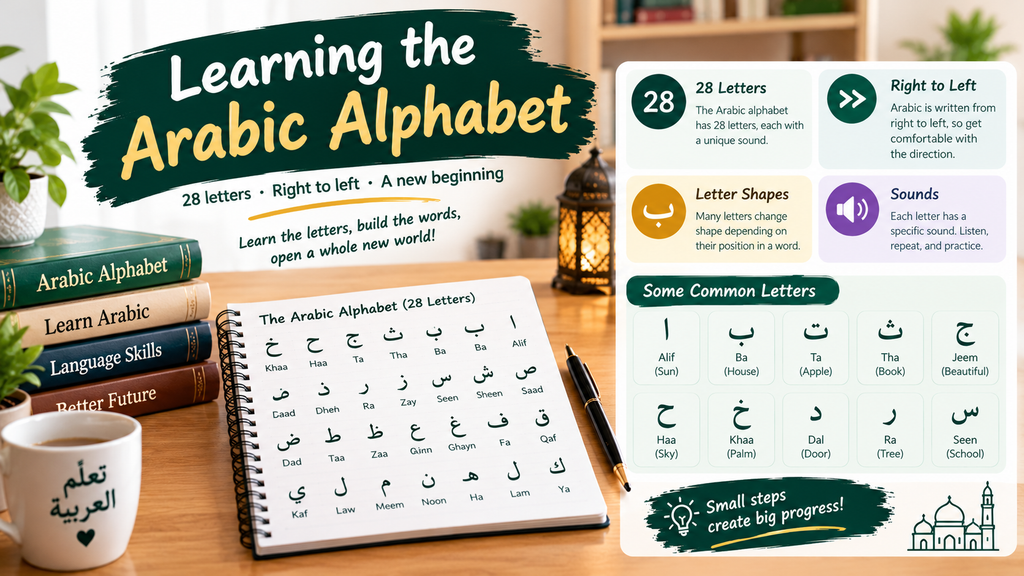
One of the first major steps for Arabic beginners is learning the Arabic alphabet. Arabic contains 28 basic letters, and many letters have different forms depending on their position within a word.
Unlike English, Arabic is written from right to left. This may feel unusual during the first few days, but learners generally become comfortable with the direction through repeated reading and writing practice.
Recognizing Arabic Letters
Beginners should initially focus on recognizing the shape and sound of each letter rather than attempting to memorize long vocabulary lists. Letters such as ب, ت, ث and ن can appear similar, with differences often indicated by the number or position of dots.
Learning these visual patterns is an essential part of Arabic reading practice. Once learners can quickly recognize individual letters, connecting them into words becomes considerably easier.
Connecting Arabic Letters: Arabic for Beginners
Many Arabic letters change their appearance depending on whether they occur at the beginning, middle, or end of a word. This is one reason Arabic writing can seem difficult to new learners.
The best approach is to practice a few letters at a time and write simple combinations repeatedly. Arabic for Beginners: Handwriting practice also helps learners develop visual familiarity with the alphabet while improving reading speed.
Arabic Pronunciation for Beginners
Pronunciation is another important area for Arabic beginners. Some Arabic sounds do not have direct equivalents in English, which means learners need time to develop accurate pronunciation.
https:\\www.britannica.com\topic\Arabic-language
Learning Difficult Arabic Sounds
Arabic includes sounds such as ع, ح, خ, غ and ق that may initially feel unfamiliar. Beginners should not become discouraged if these sounds are difficult at first. Listening carefully and repeating after native speakers can gradually improve pronunciation.
Using Arabic pronunciation practice alongside audio resources is particularly helpful. Arabic for Beginners: Instead of simply reading a word silently, learners should listen to it, Arabic for Beginners: repeat it aloud, and compare their pronunciation with a reliable example.
Short Vowels and Long Vowels
Arabic pronunciation also depends on vowel length. Arabic for Beginners: Short vowel markings can include fatḥah, kasrah, and ḍammah, while long vowels are represented through letters such as ا, و, and ي.
Understanding Arabic vowel sounds helps beginners read unfamiliar words more accurately. Arabic for Beginners: At an early stage, it is more useful to understand Arabic for Beginners: the basic system than to memorize every grammatical detail.
https:\ww.britannica.com
Building Basic Arabic Vocabulary
Vocabulary is the foundation of everyday communication. Arabic for Beginners: Arabic beginners should focus on words that are immediately useful rather than attempting to memorize thousands of unrelated terms.
Common categories include greetings, family, food, numbers, colors, places, directions, time, transportation, and daily activities. Learning words within meaningful categories makes them easier to remember.
Useful Everyday Arabic Words
Beginners can start with simple words such as “yes,” “no,” “thank you,” “please,” “hello,” and “goodbye.” These expressions provide immediate opportunities to use Arabic in real situations.
Learning Arabic greetings is particularly valuable because greetings appear frequently in conversations. Once a learner becomes comfortable with basic expressions, confidence usually increases because the language begins to feel practical rather than purely academic.
Learning Words in Context
Memorizing isolated vocabulary can become boring and inefficient. Instead, Arabic beginners should learn words inside short phrases or sentences.
For example, learning a noun together with a simple descriptive phrase can help learners understand how vocabulary works in real communication. This approach develops both Arabic vocabulary and sentence-building skills at the same time.
Basic Arabic Grammar
Arabic grammar can appear complex because the language contains grammatical structures that differ from English. However, beginners do not need to master advanced grammar immediately.
The first goal should be understanding basic sentence patterns, pronouns, nouns, adjectives, and common verbs.
Arabic Pronouns
Arabic pronouns are an important starting point because they help learners construct simple sentences. Personal pronouns include forms corresponding to “I,” “you,” “he,” “she,” “we,” and “they.”
Learning these forms allows beginners to recognize who is performing an action and provides a foundation for understanding Arabic verb conjugation.
Arabic Sentence Structure
Arabic sentences can follow different structures depending on the type of sentence. Nominal sentences, for example, commonly begin with a noun or pronoun, while verbal sentences can begin with a verb.
Beginners should focus on recognizing simple patterns rather than trying to understand every grammatical exception. Regular exposure to short sentences helps make grammar more intuitive over time.
Gender in Arabic
Arabic nouns generally have grammatical gender, commonly masculine or feminine. This affects certain adjectives, pronouns, and verb forms.
For Arabic beginners, grammatical gender can take some practice. Learning vocabulary together with its correct grammatical form is often more effective than memorizing gender rules separately.
Developing Arabic Reading Skills
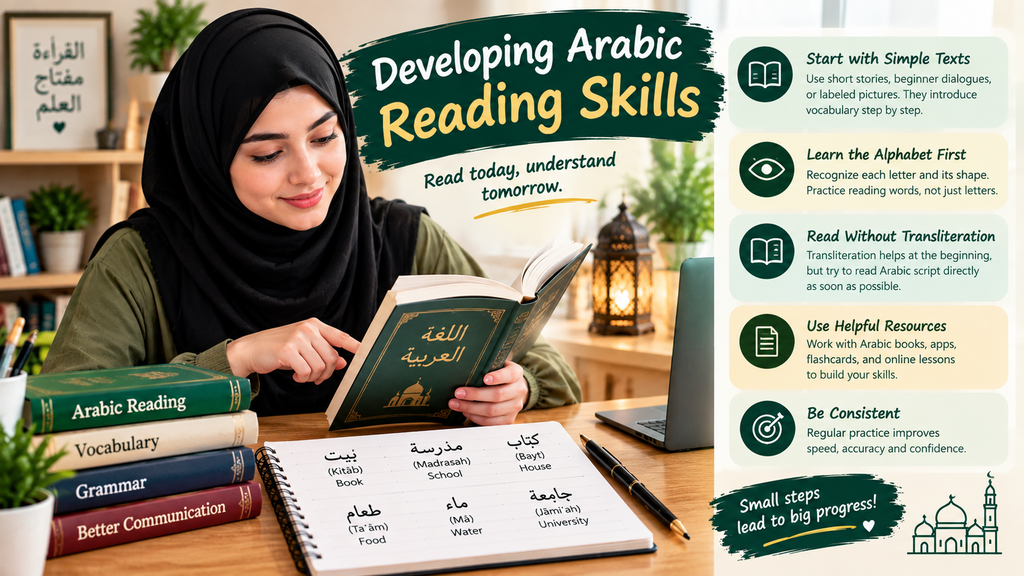
Reading is one of the most valuable skills for Arabic beginners because it reinforces vocabulary, pronunciation, spelling, and grammar simultaneously.
At first, learners should use short and clearly written material. Children’s stories, beginner dialogues, labeled pictures, and simple learning passages can be useful because they introduce vocabulary gradually.
Reading Arabic Without Transliteration
Transliteration represents Arabic sounds using Latin letters. It can help absolute beginners pronounce new words, but relying on it for too long can slow reading development.
Once the alphabet becomes familiar, learners should gradually move toward reading Arabic script directly. This develops stronger Arabic reading skills and helps learners recognize words naturally.
Improving Arabic Listening Skills
Listening is essential for anyone who wants to communicate comfortably. Arabic beginners may understand written words but struggle when native speakers talk quickly. This is normal.
Arabic spoken at natural speed can sound very different from carefully pronounced textbook examples. Regular listening practice helps learners become familiar with rhythm, pronunciation, connected speech, and regional accents.
Use Short Audio Lessons
Short recordings are often better for beginners than long conversations. Learners can listen to a sentence several times, identify familiar words, and repeat the sentence aloud.
This technique, sometimes called shadowing, can improve both listening and speaking. The learner listens to a phrase and immediately attempts to reproduce its pronunciation and rhythm.
Learning to Speak Arabic
Speaking should begin early rather than being postponed until after grammar is mastered. Arabic beginners can start with very simple sentences and gradually expand their ability.
The goal at first is communication, not perfection. Making occasional mistakes is a normal part of language learning.
Practice Simple Conversations
Learners can practice introductions, asking someone’s name, discussing where they live, ordering food, asking for directions, and talking about daily routines.
These situations provide useful Arabic conversation practice because they connect vocabulary and grammar to realistic communication.
Think in Simple Arabic
As vocabulary increases, learners can begin describing simple things around them in Arabic. They might name objects, describe the weather, or mentally form short sentences about their activities.
This gradually reduces dependence on translation and encourages more direct Arabic thinking skills.
Creating an Effective Arabic Study Routine
Consistency matters more than studying for many hours once a week. Arabic beginners can make steady progress by creating a manageable daily routine.
A short daily session might include alphabet review, vocabulary, listening, reading, and speaking practice. Even when time is limited, regular exposure keeps the language active in memory.
Practice a Little Every Day
Daily practice reinforces previous learning and reduces the need to relearn forgotten material. Reviewing yesterday’s vocabulary before learning new words can also improve long-term retention.
The most effective routine is one that a learner can realistically maintain. A simple schedule followed consistently is usually more useful than an ambitious plan that becomes difficult to continue.
Use Multiple Learning Methods
Arabic beginners can combine textbooks, audio lessons, videos, flashcards, reading materials, and conversations. Different methods strengthen different skills.
For example, flashcards can support vocabulary, audio can improve pronunciation, reading can reinforce spelling, and conversation can develop speaking confidence.
Common Mistakes Arabic Beginners Should Avoid
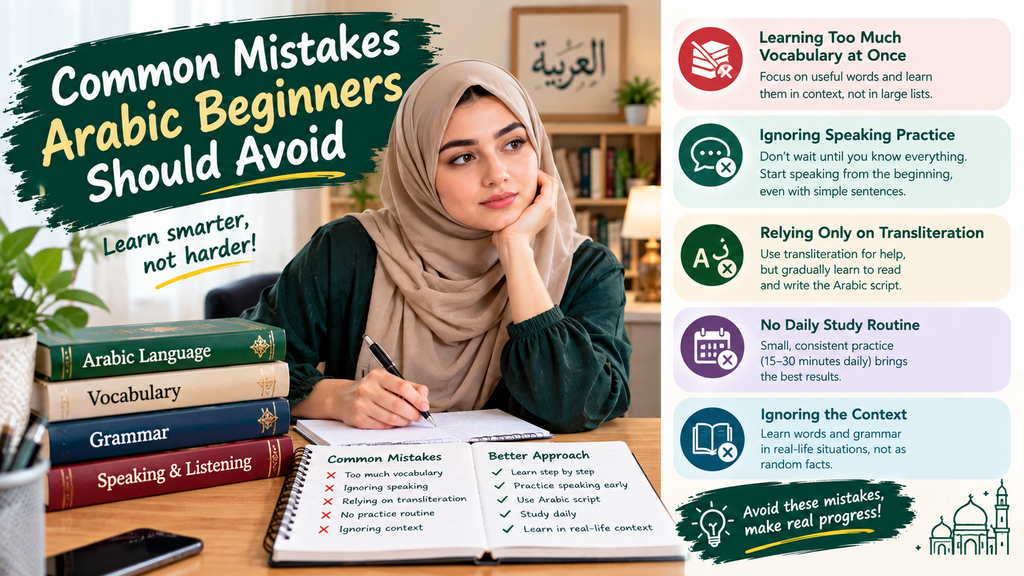
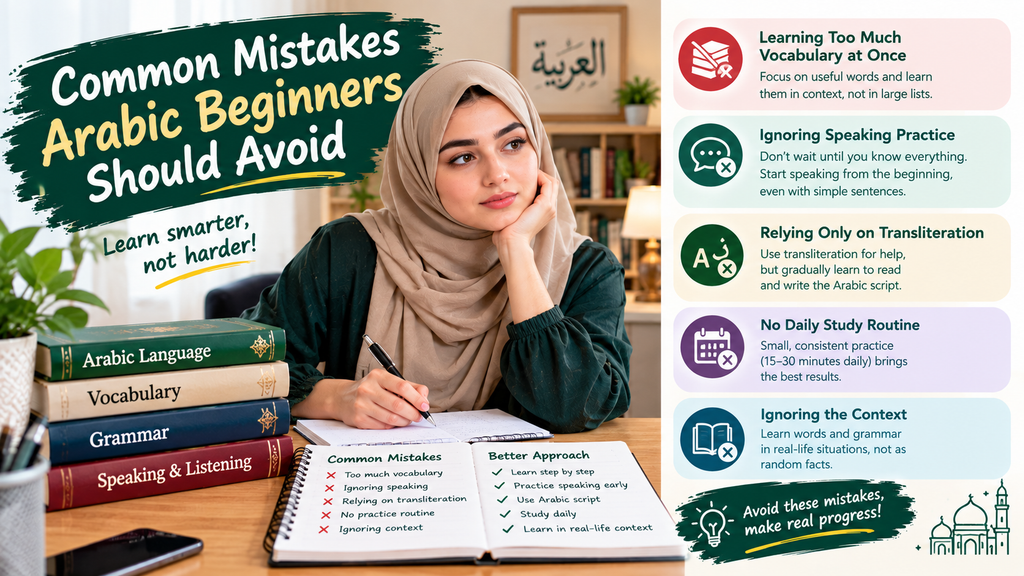
Many beginners become frustrated because they expect immediate fluency. Learning Arabic is a gradual process, and progress is rarely perfectly linear.
One common mistake is trying to learn too much vocabulary at once. Another is focusing entirely on grammar while avoiding speaking. Some learners also depend heavily on transliteration and delay learning the Arabic script.
Avoid Perfectionism
Trying to produce perfect Arabic from the beginning can create unnecessary pressure. Beginners should concentrate on communicating basic ideas and improving gradually.
Mistakes can reveal what needs additional practice. A learner who regularly uses the language will usually discover which vocabulary, pronunciation patterns, and grammatical structures require more attention.
Avoid Studying Without Context
Memorizing disconnected words may provide short-term recognition but can make actual conversation difficult. Learning vocabulary through phrases, examples, and situations gives words a practical purpose.
Context also helps learners understand how a word changes depending on the sentence and situation.
Arabic Learning Resources
Modern learners have access to many resources for learning Arabic online. Language apps, educational websites, videos, podcasts, digital dictionaries, and online classes can all contribute to progress.
However, beginners should avoid constantly switching between resources. Choosing a few reliable materials and using them consistently can create a more organized learning experience.
Arabic Dictionaries
A good Arabic dictionary can help learners understand pronunciation, meanings, word forms, and examples. Beginners should choose resources designed for learners rather than relying only on highly advanced Arabic dictionaries.
Online Arabic Courses
Structured Arabic courses for beginners can provide lessons in a logical sequence. A good course usually introduces the alphabet, pronunciation, vocabulary, grammar, reading, listening, and speaking progressively.
Online learning can also be convenient because students can study according to their own schedule.
Arabic for Travel and Everyday Life
Arabic beginners who plan to visit an Arab-speaking country can prioritize practical language. Learning directions, transportation terms, restaurant vocabulary, greetings, numbers, and basic questions can make travel easier.
Even a small amount of Arabic can make everyday interactions more meaningful. Travelers can use simple phrases when shopping, greeting people, asking for assistance, or navigating unfamiliar places.
Arabic for Work and Business
Arabic can also be valuable professionally. People working with Arabic-speaking customers, companies, or organizations may benefit from learning both everyday expressions and formal business vocabulary.
Business Arabic requires additional terminology related to meetings, contracts, finance, negotiations, and professional communication. Beginners should first establish general language skills before moving into specialized vocabulary.
Staying Motivated While Learning Arabic
Motivation can change over time, particularly when progress seems slow. Arabic beginners can maintain motivation by setting realistic goals and recognizing small improvements.
Instead of measuring progress only by fluency, learners can celebrate milestones such as reading the alphabet, understanding a short conversation, learning a certain number of words, or successfully introducing themselves in Arabic.
Set Clear Language Goals
A specific goal gives learning a clear direction. Someone may aim to read basic Arabic, hold a five-minute conversation, understand common phrases, or communicate during travel.
Clear goals make it easier to select appropriate learning materials and measure improvement.
How Long Does It Take to Learn Arabic?
There is no single answer because learning time depends on the learner’s previous language experience, study schedule, motivation, exposure, and target level.
A person practicing consistently every day will generally have more opportunities to develop skills than someone who studies only occasionally. The difficulty also depends on whether the learner wants basic conversational ability, professional fluency, academic reading skills, or advanced proficiency.
For Arabic beginners, the most productive approach is to focus on steady progress rather than a fixed deadline.
Conclusion
Learning Arabic can open the door to new cultures, conversations, literature, history, travel experiences, and professional opportunities. Although the Arabic alphabet, pronunciation, grammar, and dialect differences may initially appear challenging, each skill becomes more manageable through consistent practice.
The most important principle for Arabic beginners is to build a strong foundation gradually. Start with the alphabet and pronunciation, develop practical vocabulary, learn basic sentence structures, practice listening, and begin speaking as early as possible. Over time, these individual skills combine into meaningful communication.
Arabic does not need to be learned all at once. A few useful words today, a short conversation tomorrow, and regular reading and listening practice can create significant progress over the long term. With patience, consistency, and the right learning strategy, beginners can move from recognizing their first Arabic letters to understanding and using the language with growing confidence.
FAQs
Q. Is Arabic difficult for beginners to learn?
Arabic can seem difficult at first, but learning the alphabet, pronunciation, vocabulary, and grammar step by step makes the process easier.
Q. How should beginners start learning Arabic?
Start with the Arabic alphabet, basic pronunciation, everyday vocabulary, and simple sentences before moving to advanced grammar.
Q. How many letters are in the Arabic alphabet?
The Arabic alphabet has 28 basic letters, and many letters change their form depending on their position in a word.
Q. Should beginners learn Arabic speaking and listening together?
Yes. Regular listening and simple speaking practice help beginners improve pronunciation, understand natural speech, and build communication confidence.
Q. How long does it take to learn Arabic?
There is no fixed time because progress depends on study consistency, previous language experience, exposure, motivation, and the learner’s target level.